
Mumbling Against Babylon
Tradition, Authority, and the Lollard Crusade for Truth

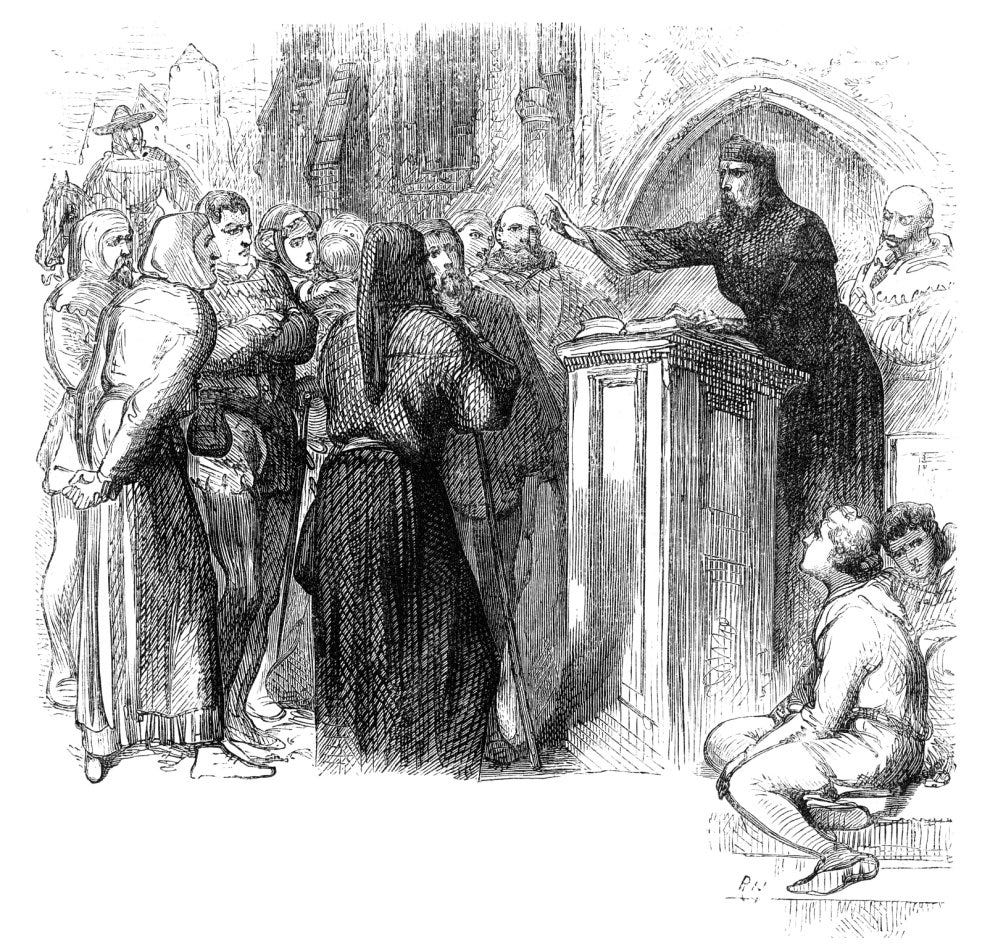
Why do rightwing Christians praise the Middle Ages? More specifically, why do Protestant rightwing Christians praise the Middle Ages? A quirk of modern politics has been the alliance between Evangelicals and Catholics, a product of post-revolutionary necessity against Jacobinism and Bolshevism. But the alliance goes deeper towards a revised appreciation for what many Protestants considered the Dark Ages of superstition and tyranny. Francis Schaeffer, the popularized and midwife of many Neo-Calvinist ideas among rightwing Evangelicals, had a high view of Medieval culture as the triumph of Christianity. Roman Catholicism was now off on doctrines like justification by faith alone, but otherwise fairly sound as a source of civilization. This Medieval society (which Calvinists like Schaeffer claimed as their heritage) was then wrecked, undermined by Scotists and Nominalists and finally blown apart by the Reformation (accidentally unleashing the forces that produced Enlightenment and Liberalism). This narrative originates with Etienne Gilson, though it has taken on a life of its own as basic common sense for most rightwingers. And despite Protestants trying to distinguish themselves from later Evangelicals, the awkward fact remains: the Reformation was the fulcrum by which Medieval Christendom was rent.
But again: why even take this path? Why do rightwing Protestants adopt a framework that fundamentally disadvantages them? Historically, it is not hard to reconstruct the reasoning. In the middle of the twentieth century, fringe rightwingers of all flavors began to coalesce and offer mutual support. Paleocons, Southern Populists, Catholic Traditionalists, even Calvinist Theonomists, began to blend and borrow from each other. A high view of the Middle Ages as peak Christian civilization began to blend with neo-Lost Cause and anti-New Deal historiography, despite this combination being unwieldy and mostly incoherent. Therefore, a Theonomist like Rousas Rushdoony found himself sympathetic to the view of a godly Confederacy against an industrial socialistic North, as well as embracing the monetary theory of Ludwig von Mises and denouncing the statism of Roosevelt. It was no surprise that Rushdoony, despite his strong Calvinist dogmatic stance, reevaluated the Middle Ages as not so bad, the flower of the gospel applied to all of life. Further downstream, to men like Schaeffer, this revised interpretation became the new common sense.
This easily verifiable, and socially sympathetic, account explains the origins of this belief. I hope it also opens the door for a way out from it. There is no reason for a rightwing Evangelical to handicap himself in defending this position. Even more, there is no reason to continue to justify the litany of crimes that traditional Protestants denounced as parts of Antichrist. One is not a squishy egalitarian liberal in rejecting the Crusades, the Inquisition, and various other things Evangelicals denounced for centuries. Rather, it takes a recovery of proper footing, a proper historiographic alternative. The rest of this essay is focused on one of those strands: the Lollards.
An English “heresy” that had an orthodox hue, like the Waldensians and unlike the neo-Gnostic Cathar, the Lollards demanded a return to the Bible and Augustine. For centuries, England had not suffered a native, grass-roots, heresy because (as historian Malcolm Lambert summarized in his Medieval Heresy) the grossest corruptions were linked to aristocratic domination over church office. English kings monopolized this process until the Plantagenet line began to tear itself apart after the death of the Black Prince Edward. Noble office mongering saw a proliferation of clerical simony, non-residency, sycophancy, and various other forms of moral corruption. For a growing class of literate, and modestly wealthy, laity, these failures demanded further reform. But the lightning rod of controversy came with the career of an Oxford scholar-priest, John Wycliffe.
Wycliffe was not a radical or a revolutionary. Rather he was a man concerned with a rot growing throughout the medieval churches, the rot of Nominalism. A movement that grew as part of a wider response to Aristotelian-Thomism, which seemed to reduce the world to a deterministic cause-and-effect machine beneath Natural Law and the First Mover, Nominalists wished to reassert the will of God. They also wished to reassert the will of man. For Nominalists, knowledge was a process of Human experience and categorization. Law was not a staid mechanism that was rigidly enforced, but required a sovereign will that imposed and altered orders of control. God was not frozen in his potentia ordinata, but always reserved the right to reassert his prerogative. However, for Wycliffe, this introduced an arbitrary, and somewhat cynical, element into government. A Nominalist policy meant that the foundations of the church militant, even its highest standard in Scripture, were subject to the whims of Human government. Canon laws and councils did not contradict so much as replace one another. Despite the fact that many Nominalists (like William of Occam) were critics of papal power, Wycliffe saw Nominalism evolve into a constant justification for moving goal posts. The only solution was to reassert a permanent and eternal standard by which God’s people could be held accountable. That standard was the Bible, the visible and plain Word of God.
In contrast to Nominalism, Wycliffe embraced an almost “ultra-realism” that saw the Scripture as the equivalent of the Platonic forms. While Nominalists may be able to secure the faith through the constantly applied (and possibly developing) will of God, Wycliffe stood on the fixed words of Scripture, with every single word as possessing an eternal significance. The Bible was not the Word of God compacted into the confused and variable words of men, but was itself eternally manifest before the creation of the World. This Word judged all contingent and creaturely institutions in flux, including the church and its officers. It was for this reason that Wycliffe veered into dangerous territory, questioning whether the eucharist was transubstantiated into the body and blood of Christ. Not only was this an iffy proposition from the Bible alone, it also made little sense. The constant and repetitious acts that encased Jesus in fallible and corruptible wafers was a blow against his eternal resurrected flesh.
But prior to this more radical step, Wycliffe used the Bible to wage a war against clerical corruption and papal pretensions. Convinced that the clergy were inventing new prerogatives for themselves to wield against God-given temporal authority, Wycliffe attacked all claims of a sacred clergy for a teaching pastorate. Priests were preachers of God’s word, they did not have a right to filch kings of their lands and property. Even more damning, they had no right to cut corners with badly behaving nobles, promising them an early escape from purgatory for bags of cash and luxurious office. The primitive purity of the Apostolic church, which was concerned for godliness and truth, was replaced with a cynical and fat clergy. The church was not the Kingdom of God on Earth, but Clerical Corp. that demanded its share of the taxes. For Wycliffe, these monstrosities demanded immediate reform, particularly from godly kings who would restrain wicked (and foreign) emissaries from Rome. Only in this way would England return to a godliness that had long since departed from the land. Despite a number of prelates wanting his head, Wycliffe had a friend in the royal prince John of Gaunt, who protected him from censure during most of his career.
To further the work of this reform, Wycliffe’s great work was not in his academic treatises on the Scripture or the eucharist, but in his translation. While clunky and somewhat rushed, dependent on the Vulgate and not the original languages, Wycliffe produced one of the first full translations of the Bible into (Middle) English. With a devoted following of reform-minded priests, Wycliffe’s translation found itself into the hands of a growing array of sympathizers. Mainly from the knightly and artisanal class, and etymologically from a Germanic word for “mumbling,” these Lollards embraced Wycliffe’s cry for reform, to return to the Apostolic deposit and wipe out the modern corruptions of their age. In the hands of Geoffrey Chaucer, a Lollard sympathizer at the very least, the Wycliffite Parson stood juxtaposed as virtuous to the worldling Monk and gossip-mongering Friar in their journey along the Canterbury trail. These criticisms were forbidden by law, and most Lollards found themselves in secret gatherings to distribute texts, read Scripture, and share their wider criticisms of a debauched and ignorant age.
Lollardy took root because it had concrete and straightforward criticism. The concern was not replicating Wycliffite doctrine, but opening up the Bible afresh. The simple, but not simplistic, promises of the Gospel and obedience to God’s law had been buried through corruptions and accretions. The power of an omnipotent and incorporeal Jehovah was not containable in relics, pilgrimage sites, or statues, which often absorbed the bulk of vulgar piety. Thus Lollards turned their scorn on these peasant superstitions. Moldy cloths and dusty bones were treated as sites of divine power, when they were more often than not frauds. There was something perverse about men prostrating before dirt and dirty objects when they were made with the reason of an imago Dei. Pilgrimage sites had no biblical demand, offered a false sense of religiosity, and often served a Medieval tourist economy that was soaked through with booze and hookers. What was even more galling was to watch men prostrate before a wormy piece of bread, treating it as the very presence of God when the Lord had said the Kingdom of God is within you. Obese friars, pederast priests, ignorant dissimulators of piety (where prayers were exchanged for money), the Lollards hated them all and poured scorn on these as so many devil worshipers. These were all products of Roman captivity, a stark denunciation from the Lollard confession Twelve Conclusions, that declared war against antichrist papacy:
When the Church of England began to dote in temporality after her stepmother, the great Church of Rome, and churches were slain by appropriation to diverse places. Faith, Hope, and Charity began for to flee out of our Church.
In simple terms: were Christians the race of saints that remade the world to befit the New Jerusalem? Or were they slavish, superstitious, cretins beneath the slippered heel of unworthy clerical masters? Were Christians the children of Heaven, or fearfully trying to cheat the nearly unending fires of Purgatory through purchased merits? Lollards also found the Crusades to be a filthy perversion of Christian piety, waging wars for popes to acquire new wealth, emptying European lands of their best sons. Before someone immediately jumps to Islam and clash-of-civilizations, it is worth thinking the tragicomic failure of so many Crusades (e.g. Fourth Crusade, Children’s Crusade) and the kind of petty dynastic feuds that erupted from the pseudo-principalities on the Levant. Lollards had a point about spilling blood for false promises in forever wars that took place far away from home.
But this condemnation of violence did not mean Lollards were unwilling to fight. Sir John Oldcastle was the zenith of knightly Lollardy, frustrated with the submission of godly laity to less than godly clergy. Likely the basis for Shakespeare’s Falstaff, Henry V rued having to punish his old friend, but the need of “orthodoxy” and good relations with Rome sealed his decision to see these heretics burn. Despite this turn seeing many knights forced to hide their Lollard faith to the point of abandonment, Lollardy continued among craftsmen and artisans, literate and out of the spotlight, to continue their desires for reform. Under threat of death, some of these Lollards abjured, giving written witness to their beliefs and practices. While unlikely under the current crop of Plantagenet kings, Lollards persevered in making the Bible accessible in an age of debauched elites and clerks. The Bible alone was the supreme authority, a dream realized with the coming of the Protestant Reformation. It was thus fairly reasonable for these faithful biblicists to be treated as forbearers to the Evangelical bishops in the Church of England. John Foxe saw Lollards, not the Medieval hierarchy, as the bridge between the Apostles and the Reformers through a dark and ignorant age. Contrary to many self-professed Traditionalists, who have no meaningful grounds to interpret the traditions that are now being actively subverted by the Magisterium against them, the Lollards appealed to a fixed and unchanged standard in the Bible. They alone could call the entire institutional edifice into question so as to preserve the true faith that the wicked assaulted day and night.
It is this heritage that provides a rightwing Protestant with self-awareness and virility in an age where Traditionalists cannibalize themselves, being crushed between their own imperious fractiousness and official papal hostility. Why play this game? Modern traditionalists do not substantively believe in the peasant religion of relics and pilgrimages. It is, first and foremost, a civilizational technology, the social basis upon which Western Civilization grows. But while this assertion begs the question of its validity, the average American Evangelical, standing with his Bible tucked under his arm, remains across the board faithful on all major social issues that plague modern Western society. They even vote, above every other demographic, for Donald Trump, who has declared bureaucratic war on ecclesiastical institutions and their clerks that consistently subvert national law. Contrary to the grating and bitter laments of Traditionalists, it turns out you can just read the Bible and find your way to the truth. The noxious fumes of postmodernism dissipate. You really can ride the hermeneutic spiral and find yourself towards the everlasting.
The Western Anglophone Evangelicals need not find civilization or virtue in slavish prostration before authorities that constantly betray and exploit them. Even if you can only mumble the Word of God, even if that is all that can be mustered, Babylon will still fall. Such is the power in the Word of God. Such is a power still at work today.
there were only ever 4 actual crusades the pope authorized, one was very successful one was moderately successful one was a failure and one was bad