
Evolving Creation?
Asa Gray and Evangelical Orthodoxy at the Threshold of Modernism

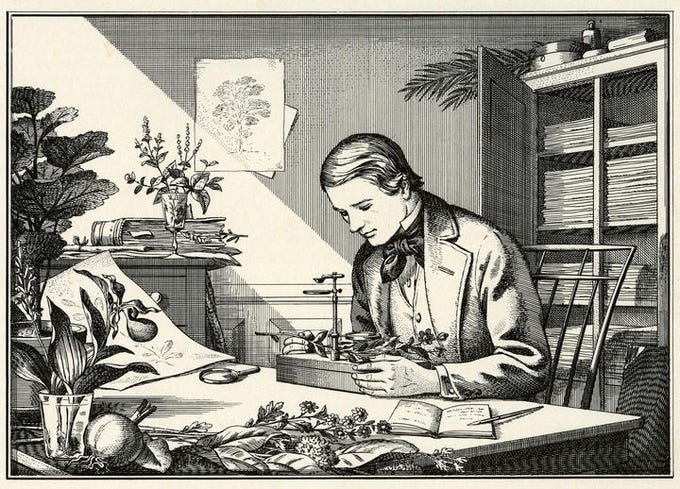
Asa Gray stood at the threshold of the Evangelical crisis. As one of the premier scientists of the nineteenth century, a unique American contribution in a sea of Europeans, Gray was both an orthodox Calvinist and an evolutionist. Nearly beating Gregor Mendel to the discovery of genetics, Gray stood against the doctrinaire agnosticism of Thomas Huxley and Herbert Spencer, the circle around Darwin who popularized his theories and supposedly misrepresented their master. Instead, Gray defended Darwinism (natural selection, descent with modification) as not only compatible with theism, but a sure proof of theism against the regnant materialism of his contemporaries. While Gray would later be embarrassed with Darwin’s more explicit drift towards agnosticism, he would never accept the criticisms of his fellow orthodox Calvinists, be he Charles Hodge or Robert Dabney, that Darwinism was incompatible with faith. Rather, Gray’s apology for Darwin opens a vista on rethinking the core theological problems of evolution and creation, their origins in a very different set of categories.
The problem was not mechanism, but Naturphilosophie. Over the course of the nineteenth century, philosophy and natural philosophy (the sciences) had drifted against the occult mechanisms of Newton. German Idealism had depicted an interlocked organic world that pulsed with life. These Romantics toppled the watch-maker tyrant of Christo-Deism (which Wordsworth most vividly depicted in Prometheus Unbound) and exalted Nature. The world was god-intoxicating because the world was God. Pantheism became regnant (that dark night, Hegel would later mock, in which all sheep are black). This Naturphilosophie would also dominate Western biology, particularly in the immigrant and premier American scientist, Louis Aggasiz. Life burst forth from life, nearly spontaneously, and it followed the ever-churning of Nature. Aggasiz had defended a kind of materialist creationism, that all the various species appeared in their own form according to Nature’s generations. The whole formed the particulars and thus individual organs were formed according to function.
Aggasiz was Gray’s foe, who appealed to empiricism against idealism. When the biologist discovered seemingly useless organs, how could Aggasiz defend them? Charles Darwin and Alfred Wallace had led a counterattack against this pantheistic creationism, noticing that organisms appeared adapted to their environment, rather than a randomly generated manifestation of holistic Nature. Some organs appeared vestigial, no longer in use, remnants of organs that lay dormant in the organism without contributing much to their function. Aggasiz had denied the meaning of these vestigial organs, whereas Darwin had discerned some logic behind their existence.
Against Naturphilosophie and its American advocates (such as the Transcendentalists, like Thoreau and Emerson), Gray rejected this pantheistic, magical materialist, creationism, Nature spitting out combinations that conformed to the existent sea of being. Against randomness, Gray saw “evolutionary teleology” (as he named his final essay in his Darwiniana [1876]) as proof of Providence. When biologists saw so many organs that seemed redundant, useless, or wasteful, it was proof of God’s plan over time. When biologists found a variety of organs that were nearly similar, but performed a variety of functions (as if they adapted to aid the survival of the organism), God guided the direction of these changes. It was Darwin’s theory that revealed Christian Providence in Nature against the pantheists:
By the adoption of the Darwinian hypothesis, or something like it, which we incline to favor, many of the difficulties are obviated, and others diminished. In the comprehensive and far-reaching teleology which may take the place of the former narrow conceptions, organs and even faculties, useless to the individual, find their explanation and reason of being. Either they have done service in the past, or they may do service in the future. They may have been essentially useful in one way in a past species, and, though now functionless, they may be turned to useful account in some very different way hereafter. In botany several cases come to our mind which suggest such interpretation.
Under this view, moreover, waste of life and material in organic Nature ceases to be utterly inexplicable, because it ceases to be objectless. It is seen to be a part of the general “economy of Nature,” a phrase which has a real meaning. (Darwiniana, 375)
Redundant, useless, or wasteful organs or systems were not signs of randomness, unless one already presupposed randomness. Rather, it revealed God’s cunning. Creation was not something done in an instant, but was ongoing through the ages, creatures molded and changed as they moved across the vast expanse of God’s world, all of which was in his Providence. God did not create as if he started at the beginning, but God is beyond time, seeing beginning and end simultaneously. The whole plan was not necessarily visible in any particular moment. If God could so foreordain Joseph’s enslavement, through the treachery of his brothers, to save both Egypt and his own people, how much more could God ordain the various adaptations through natural selection to the developments of creatures to his glory? What the environment meant for evil, God meant for good.
Of course, these claims could be a convenient just-so story to explain away disorder. Hume noted, long before Darwin in his Dialogues Concerning Natural Religion (1779), the problem with all arguments for design are in the perspective. The order of the spheres happened alongside seemingly useless destruction and catastrophe. Gray was not unaware of this problem, but this further strengthened his case:
What results are comprehended in a plan, and what are incidental, is often more than we can readily determine in matters open to observation. And in plans executed mediately or indirectly, and for ends comprehensive and far-reaching, many purposed steps must appear to us incidental or meaningless. But the higher the intelligence, the more fully will the incidents enter into the plan, and the more universal and interconnected may the ends be. Trite as the remark is, it would seem still needful to insist that the failure of a finite being to compass the designs of an infinite mind should not invalidate its conclusions respecting proximate ends which he can understand. (Darwiniana, 380)
In other words, Gray, as a good empiricist, ends up a presuppositionalist through the backdoor. One must have a vision of the whole, which no concatenation of observations and facts can grant, to understand the arrangement of the whole. One must understand the plan to understand the significance of action. In an earlier essay, “Design Versus Necessity, a Discussion” (1860), Gray compared natural teleology to two pool players shooting from different sides of the table, striking their balls in the middle and redirecting them. This distinguishes mere actions from intent:
Now, let it be remarked that design can never be demonstrated. “Witnessing the act does not make known the design, as we have seen in the case assumed for the basis of the argument. The word of the actor is not proof; and that source of evidence is excluded from the cases in question. The only way left, and the only possible way in cases where testimony is out of the question, is to infer the design from the result, or from arrangements which strike us as adapted or intended to produce a certain result, which affords a presumption of design. The strength of this presumption may be zero, or an even chance, as perhaps it is in the assumed case; but the probability of design will increase with the particularity of the act, the specialty of the arrangement or machinery, and with the number of identical or yet more of similar and analogous instances, until it rises to a moral certainty—i. e., to a conviction which practically we are as unable to resist as we are to deny the cogency of a mathematical demonstration.” — in relation to the example of two pool players having their balls connect as they struck in opposite directions (north to south pocket, west to east pocket). (Darwiniana, 70)
Gray also used the example of a man striking another man with a boomerang. Superficially, a man throwing a curved stick away from a man seems to have no ill intention. But given enough throws, and the discovery of the concept of a boomerang, even the greatest imbecile will begin to suspect that the man is trying to hit him. How can anyone know if the two pool players are trying to hit their balls in the middle? Do the players even know? The plan, and the mind of the planner, would have to be presupposed to make sense of the coherence of actions that accomplish their goal. In the realm of biology, it was life always moving to find a way against hostile conditions. The design behind natural selection accumulates in the same way that watching those two pool players, time and again, strike in the middle may create the inference that they know what they are doing. Of course, these collisions may be a series of coincidences. There is no amount of demonstrations that can ever prove design.
Therefore, given the plethora of these examples of seemingly redundant/useless/wasteful organs in Nature, one must either presume a great design or sheer randomness of ever-churning Nature:
It is very easy to assume that, because events in Nature are in one sense accidental, and the operative forces which bring them to pass are themselves blind and unintelligent (physically considered, all forces are), therefore they are undirected, or that he who describes these events as the results of such forces thereby assumes that they are undirected. This is the assumption of the Boston reviewers, and of Mr. Agassiz, who insists that the only alternative to the doctrine, that all organized beings were supernaturally created just as they are, is, that they have arisen spontaneously through the omnipotence of matter. (Darwiniana, 153-154)
It was Darwin that armed the Christian to assert the scientific basis of Providence. Here was a teleological, and theistic, evolution against materialist creationism, God against Chance. While many other orthodox Christians considered Darwin as further atheism in the reign of randomness, Gray was not entirely alone. He found a friend in fellow Yankee and orthodox Calvinist, George F. Wright, who had prompted him to collect and edit the Darwiniana. Wright was a Congregationalist minister and geologist. He would remain committed to creationism, even as he had to let go of some aspects of evolution as Darwin’s agnosticism became undeniable. Even so, this later contributor to The Fundamentals against theological liberalism, remained committed to theistic evolution. Wright would go even further than Gray in arguing that Darwinism shored up Calvinism as the proper interpretation of natural revelation:
Wright contributed to the discussion the idea that the tenets of Calvinistic theology had much in common with Darwinism. For instance, he said that the “Calvinistic doctrine of the spread of sin from Adam to his descendants has also its illustrative analogies in the Darwinian principle of heredity.” Also, the “adjustment of the doctrines of foreordination and free-will occasions perplexity to the Calvinist in a manner strikingly like that experienced by the Darwinian in stating the consistency of his system of evolution with the existence of manifest design in nature.” (A. Hunter Dupree, Asa Gray, 1810-1888, 363)
Gray and Wright would later fade from the scene as the Fundamentalist/Modernist Controversy would place Darwin surely on the side of the Agnostics. Many Christians agreed with their Spencerian liberal opponents, if Darwin was right than the Bible was wrong. It was not that Darwin created theological liberalism, but theological liberals shifted from Naturphilosophie to Darwinian evolution as the exuberance of liberalism waned. Darwin was something of a conservative, though ameliorative, rearguard defense against the further development of liberal revolution, where Idealism (albeit turned on its head) found a full expression in Socialism, especially Marxism.
Socialists did not altogether accept the Darwinian, and neo-Darwinian (after integration with Mendelian genetics), paradigm of finding adaptability within individuals. Instead Lamarck made a return, a Naturphilosophie that was shaping and guiding Human history towards an evolutionary rebirth. Neo-Lamarckian theories marked Socialist sciences, particularly in the Soviet Union and its variations in the form of Lysenkoism (often conclusively blamed for the rippling famines that nearly killed more Communists than the Third Reich). Liberal Darwinists and orthodox Christians in the West often joined forces against the pantheists and their magical materialism, but that was a lopsided partnership. Creationism has fled, legally and educationally, from the public. Creationism now only exists in nooks and crannies of home schools and Christian private schools, reduced to a disreputable opinion that kooky and dimwitted Evangelicals maintain.
Of course, modernist Christians accept orthodox neo-Darwinism and what it entails for the Bible. Even the Vatican accepts a “theistic evolution” which makes the account of Genesis a pious myth at best, bronze age nonsense from barbarians at worse. The current debate is between the reliability of Scripture against the scientific consensus. Critics may point out that neo-Darwinism has changed significantly from the Victorian era, and that many of Darwin’s theories have been modified beyond recognition, but that has done little to dislodge the basic paradigm.
But that may simply be the wrong way to frame the problem. What Gray understood was that Darwin was a question of mechanism or means, not why. Many Creationists accept the basic mechanisms of evolution (descent with modification, natural selection) without its cosmology. Does knowledge of evolution require a particular history to life? Darwin had come to believe that all living organisms had descended from an original life-form, usually told in the mythologeme of a lightning bolt striking a soup of amino acids. Is that the case? The problem was not evolution, but a certain interpretation of natural history through geology, where there was progressive, not catastrophic, development that could be read as ages. Only if Earth is billions of years old with incremental development of life that the standard Darwinian attack on Creationism holds. But apocalypticism (repressed for political reasons as much as, or maybe even more than, theoretical failures) has made an increasing return. The uncontroversial theory of punctuated equilibrium would see massive changes in life-form that interrupted periods of stability. There is no reason to interpret these demonstrations according to a barren and dead cosmos.
Darwin had begun his work with an account of domesticated animals, their variety of breeds that look remarkably different. Wild cows may be mistaken, at first blush, for a different animal than the standard meat and milk cows of industrial factories. Man plays the role of the designer on his farms, creating a variety of life-forms to serve particular designs and plans. Evolution is true, but perhaps within certain limits, according to certain kinds. Modern Darwinists reflect the same incoherent conclusions of modern globalists. The fact that national identity can be blurred on the edges does not mean nations do not exist. In a different light, one may note that God established seventy nations in Genesis, and yet those nations do not exist, at least not in any original form, by the time of the New Testament. God created all nations from one blood, as St Paul preached in Athens (Acts 17), and yet these nations still persist as distinct races, with their own borders and cultures. The kinds of creation are not fictive taxonomical categories, anymore than national existences are fictions of international law. The natural selection of various kinds into various forms does not deny divine election in the calling of the saints.
The problem is paradigmatic. All accounts of non-biblical natural history invent just-so stories. All evolutionary science can demonstrate is the mechanism, not the whole scope of its occurrence. Appeals to geology are just as unreliable as in Darwin’s day, where opponents of evolution argued that the fossil levels did not bear out incremental development. That cuts both ways, requiring a presupposition of a framework to interpret the evidence, even if the framework is not arbitrary. Evolution also does not require any singular or unitary origin point, something Darwin believed originally, as well as Gray. Evolution was not an iron law of nature, but the normative means of continued and active Providence. Returning to Gray, there was no need to equate design with a miraculous, spontaneous, appearance:
If he cannot recognize design in Nature because of evolution, he may be ranked with those of whom it was said, “Except ye see signs and wonders ye will not believe.” How strange that a convinced theist should be so prone to associate design only with miracle!
All turns, however, upon what is meant by this Nature, to which it appears more and more probable that the being and becoming—no less than the well-being and succession—of species and genera, as well as of individuals, are committed. (Darwiniana, 389)
The problem with Darwinism, ultimately, is its implicit cosmology, one that is sometimes shared with some Creationists that fundamentally brackets Providence. God the Creator is almost treated as the Deist watchmaker. Instead, Gray’s creative adaptation can be leveraged further. Again, there is no reason to accept actual boundaries between kinds even as there is wild diversity from within. There is also no reason to think that rapid changes cannot be a Providential design in and through history. Therefore, one can suppose, following the mythopoetic history of Genesis, that God created kinds that would find rapid change in a cursed post-Edenic world. Noah’s ark did not need to preserve every single variation and breed along an evolutionary branch as long as it preserved the kind. It was, perhaps, the vile antediluvian world that produced horrible and vicious birds that today are referred to as dinosaurs. The current extinction of species does not mean man has overcome man’s creation. Natural history and man’s history are integrally intertwined, where God preserves kinds as God preserves man. It does not mean all creatures are equal or have the same longevity, even as the general race persists. There are no more Amorites or Hittites, yet man survives. There is unity in Adam, but that does not mean a Roman is a Papuan.
These considerations are not for doctrinaire agnostics. An atheist scientist may scoff at the appeal to Genesis as so much mumbo-jumbo, but has an instinctive attachment to the questionable Out of Africa theory. Even more, every agnostic scientist accepts non-empirical claims about the possibility of his research, such as the uniformity and intelligibility of nature. Why suppose that an ape brain can learn anything about the nature of the world, except in as much as it seems to work? A biologist has no reason to accept the equality of races, anymore than a neuropsychologists accepts free-will, yet both act as if they are true in their interactions with the world. One cannot prove that human rights exist, and yet the standard academic will without fault pull the lever for the center-left or left candidate. The point is not that they are wrong intrinsically, but rather they cannot give an account of the paradigms they utilize. Appeals to decency and Human progress are just as mythopoetic as the revealed Law in Genesis, though ones that are even more empirically ridiculous. It is to take the boomeranged man as a victim of random circumstances, correctable through school lunches and counseling services.
When it comes to presuppositions and a “worldview,” it is not the question of a randomly confected paradigm to explain events ad hoc. It is not merely the venerable status of the Bible, but its maximal coherence in interpretation of Human history and, arguably, natural history. The idea of an originally good man that has fallen and has destroyed the world with him seems to have played out as millennia of the two pool players synchronizing their shots. The Bible is science, it is knowledge of the shape of the world and its progression. It is a glimmer of Providence, the plan that all things, be they flora or fauna, follow, willingly or unwillingly. This claim does not mean the Bible has instructions on how animals and plants procreate, but it does explain what this progeny means.
There is no need to repeat errors with dubious moral evaluations about how Darwin led to imperialism and racism. There is no need for naive, and false, appeals to naturalistic design. Creation is not so much a theory of science, but the science itself, an interpretation of the facts that requires a paradigm beyond mere naked facts. One does not need to lapse into the insipid idealism of Naturphilosophie to stand against halfwit mongers of the empirical. There is a dynamic relationship between interpreter and the interpreted that, while unfolding through time, may receive a revelation of the eternal. The problem is, as George F. Wright forcefully understood, was not empirical observations, let alone the theories that bubbled up from these investigations. It was always the presupposed cosmology behind these:
The worst foes of Christianity are not physicists but metaphysicians. Hume is more dangerous than Darwin; the agnosticism of Hamilton and Mansel is harder to meet than that of Tyndall and Huxley; the fatalism of the philosophers is more to he dreaded than the materialism of any scientific men. The sophistries of the Socratic philosophy touching the freedom of the will are more subtle than those of the Spencerian school. Christianity, being a religion of fact and history, is a free-born son in the family of the inductive sciences, and is not specially hampered by the paradoxes inevitably connected with all attempts to give expression to ultimate conceptions of truth. The field is now as free as it has ever been to those who are content to act upon such positive evidence of the truth of Christianity as the Creator has been pleased to afford them. The evidence for evolution, even in its milder form, does not begin to be as strong as that for the revelation of God in the Bible. (“The Passing of Evolution”)
The generation, regeneration, and degeneration of orders that have seemingly apparent boundaries, in nature as much as in history. These facts conform fully to the biblical account of life, the world, and man. Such is the cunning of a solemn Providence, from whom all things flow and to whom all things bend.