
Capturing Leviathan
Theodicy and Cosmic War in the Book of Job

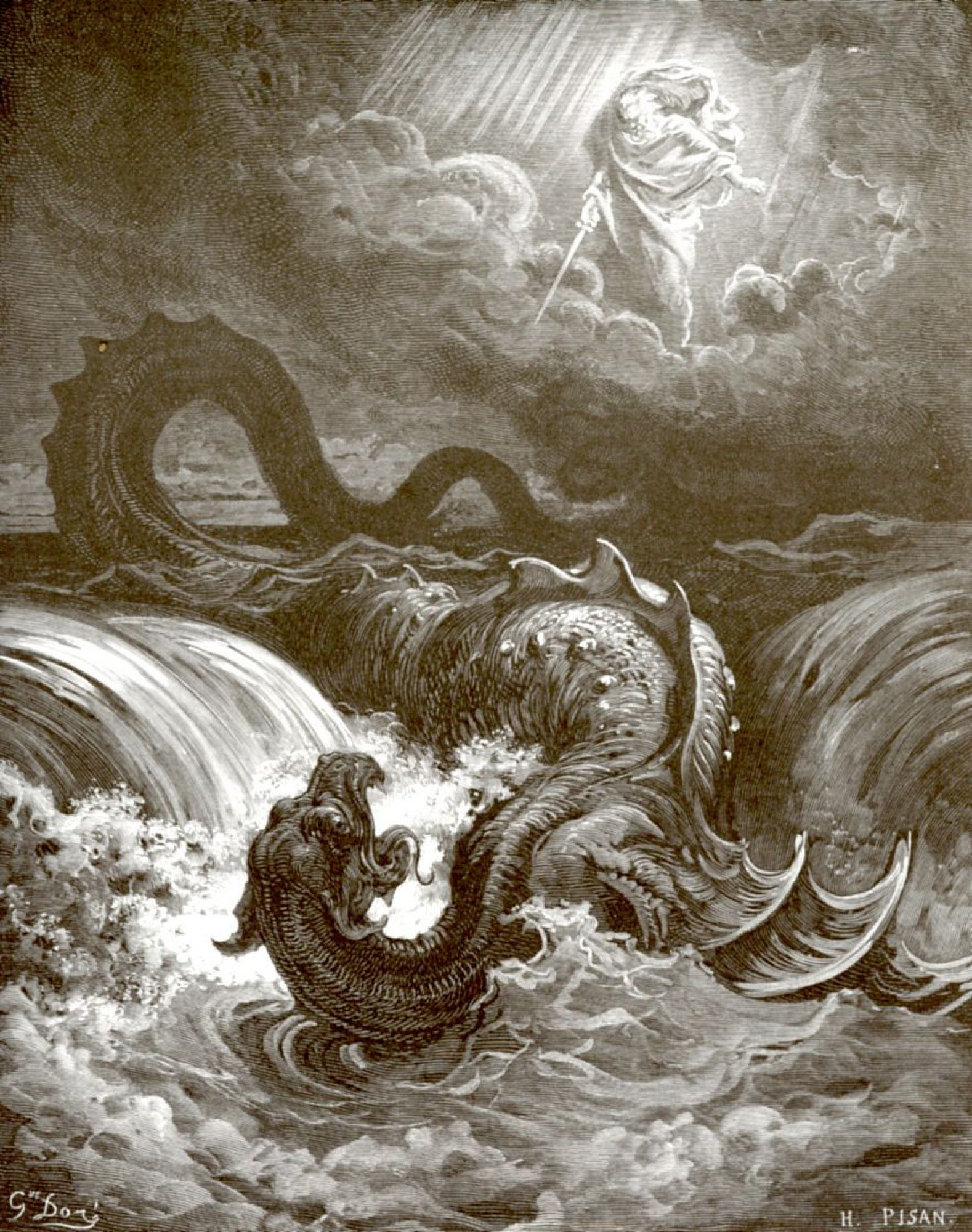
In many readings of the Book of Job, there is no answer to the sufferings of the righteous. God and “the satan” make a wager, unbeknownst to mortals, and King Job is afflicted to the breaking point. Job’s children die, his livestock is wiped out, and his health evaporates into aching boils. His sneering wife can only advise him to curse God and die. Job’s friends, his informal royal counselors, can only apply standard (but untrue) theodicy. Job must have sinned to deserve such punishment, or there is nothing unusual in these punishments and Job must endure for the Lord works in mysterious ways. Job lamented bitterly because he believed that God was just and Job was innocent. These two wrack Job to the point of despair, though believing someone, some redeemer, would plead his case in the divine council. Finally, the Lord appears in the whirlwind, battering Job with a series of seemingly accusatory questions. Appearing to relent before divine omnipotence and Human ignorance, Job is restored, with a bountiful increase of children and wealth as his health is restored.
What exactly is learned here? What is the lesson?
A quick reading, often proffered, informs the audience that Man has no right to question God’s providence. Job should have submitted to the punishments because the Lord is almighty. Did Job know how the sun works? Or snow? Or the wind? What about the many animals who, by instinct, preserve themselves and their species in a complex, competitive, ecosystem? Having been told to gird his loins like a man, Job must admit defeat before the Lord, who alone governed Heaven and Earth. Deferrence before omnipotence, faith in the almighty, is the only solution.
And while faith is the ultimate remedy for Job, the string of questions seems irrelevant. Why does knowledge of nature (or lack thereof) determine whether Job was worthy of suffering? God’s rhetorical questions do not seem to rationally answer Job’s plea that he was blameless to suffer such catastrophe. In some critical readings, such as Carl Jung’s, Job secretly won the argument. God really had no good reason and only can appeal to providential omnipotence. But Job was blameless (as so many men who suffer for no seeming reason) and God must recognize that sometimes his children have a point. In this archetypal psychological interpretation, Man’s maturity depends on overcoming the shadows of the divine, the inexplicable presence of the wicked satan in the benevolent court of Heaven. Only when Man acknowledges that “God” does not have all the answers, that rational mortals must overcome their own suffering, their own creaturely limits, through acceptance. When Job can forgive God, then a new age of Human autonomy may dawn.
While this interpretation may appear attractive to the heroic liberals of previous eras, it can hardly fit the text in question or the spirit of the Bible. But if this hermeneutic is not deployed, what explains the turn in Job’s heart? Why does he submit to the Lord’s questions?
The answer comes in reference to two mighty, supernatural, entities: Leviathan and Behemoth. Before God asks Job about these monsters, he first asks Job to once again prepare himself:
“Gird up thy loins now like a man: I will demand of thee, and declare thou unto me.
Wilt thou also disannul my judgment? wilt thou condemn me, that thou mayest be righteous?
Hast thou an arm like God? or canst thou thunder with a voice like him?
Deck thyself now with majesty and excellency; and array thyself with glory and beauty.
Cast abroad the rage of thy wrath: and behold every one that is proud, and abase him.
Look on every one that is proud, and bring him low; and tread down the wicked in their place.
Hide them in the dust together; and bind their faces in secret.
Then will I also confess unto thee that thine own right hand can save thee.” (Job 40:10-14)
God not only asks Job to “man-up” but to be arrayed as a divine judge. Job was not simply a mortal creature bombarded with the unknowns of nature, but to appear as a member of the divine council. If Leviathan and Behemoth were strictly beasts, Job would not need to stand as a judge. Behemoth was not merely a monster, but could devour the Jordan:
“Behold now behemoth, which I made with thee; he eateth grass as an ox.
Lo now, his strength is in his loins, and his force is in the navel of his belly.
He moveth his tail like a cedar: the sinews of his stones are wrapped together.
His bones are as strong pieces of brass; his bones are like bars of iron.
He is the chief of the ways of God: he that made him can make his sword to approach unto him.
Surely the mountains bring him forth food, where all the beasts of the field play.
He lieth under the shady trees, in the covert of the reed, and fens.
The shady trees cover him with their shadow; the willows of the brook compass him about.
Behold, he drinketh up a river, and hasteth not: he trusteth that he can draw up Jordan into his mouth.
He taketh it with his eyes: his nose pierceth through snares.” (Job 40:15-24)
As the core border between the promised Land and the swirling chaos of the Nations, Behemoth was a primordial agent of chaos. Similarly, Leviathan was far more than a mere sea beast:
“He esteemeth iron as straw, and brass as rotten wood.
The arrow cannot make him flee: slingstones are turned with him into stubble.
Darts are counted as stubble: he laugheth at the shaking of a spear.
Sharp stones are under him: he spreadeth sharp pointed things upon the mire.
He maketh the deep to boil like a pot: he maketh the sea like a pot of ointment.
He maketh a path to shine after him; one would think the deep to be hoary.
Upon earth there is not his like, who is made without fear.
He beholdeth all high things: he is a king over all the children of pride.” (Job 41:27-34)
More than a mere dragon, impervious to man’s weapons, Leviathan is the father of the prideful. This description of a creature immune to carnal weapons is not unlike the Apostle Paul’s description of the Christian’s fight:
“For we wrestle not against flesh and blood, but against principalities, against powers, against the rulers of the darkness of this world, against spiritual wickedness in high places.” (Ephesians 6:12)
If Job is not simply contending against a beast, it makes sense that he is arrayed as a heavenly judge. And what, exactly, are these beasts he is judging? Returning to the beginning of the text, God asked “the Satan” where he has been, since he was no native to the council. His native domain is the wilderness, the unformed and unclaimed realms that Man was sent to tame and conquer for Eden. Why is this “accuser,” this prosecutorial figure, in God’s court if he is from the realms of darkness? What if this Satan is none other than the Leviathan that Job is called to subdue? What if this Leviathan is, in his serpentine watery appearance, none other than the snake that infiltrated the Garden and asked Adam, in pride, to seize a divine mantle? It would fit the other oblique references to a divine, but dark, force that rebelled against Heaven and sought to destroy mankind. One example is found in Isaiah’s condemnation of the “Prince of Babylon,” who appears to be more than a mere mortal king:
“How art thou fallen from heaven, O Lucifer, son of the morning! how art thou cut down to the ground, which didst weaken the nations!
For thou hast said in thine heart, I will ascend into heaven, I will exalt my throne above the stars of God: I will sit also upon the mount of the congregation, in the sides of the north:
I will ascend above the heights of the clouds; I will be like the most High.
Yet thou shalt be brought down to hell, to the sides of the pit.” (Isaiah 14:12-15)
It is possible that the prophet simply denounces the hubris of great emperors, but these claims appear even more ancient and grandiose than any one king of Babylon, one who aspires not only to rule as God but requires punishment to face the death of the pit. Like in Daniel, whose “Prince of Israel” is the angelic Michael and the “Prince of Greece” is clearly a spiritual force, the “Prince of Babylon” is the dark force behind the throne, seeking something beyond mere earthly conquests.
Similarly, the prophet Ezekiel denounced the “Prince of Tyre,” who also had aspirations and powers (and origins) far beyond the powers of a mere ruler of a city-state:
“Thus saith the Lord God; Thou sealest up the sum, full of wisdom, and perfect in beauty.
Thou hast been in Eden the garden of God; every precious stone was thy covering, the sardius, topaz, and the diamond, the beryl, the onyx, and the jasper, the sapphire, the emerald, and the carbuncle, and gold: the workmanship of thy tabrets and of thy pipes was prepared in thee in the day that thou wast created.
Thou art the anointed cherub that covereth; and I have set thee so: thou wast upon the holy mountain of God; thou hast walked up and down in the midst of the stones of fire.
Thou wast perfect in thy ways from the day that thou wast created, till iniquity was found in thee.
By the multitude of thy merchandise they have filled the midst of thee with violence, and thou hast sinned: therefore I will cast thee as profane out of the mountain of God: and I will destroy thee, O covering cherub, from the midst of the stones of fire.
Thine heart was lifted up because of thy beauty, thou hast corrupted thy wisdom by reason of thy brightness: I will cast thee to the ground, I will lay thee before kings, that they may behold thee.
Thou hast defiled thy sanctuaries by the multitude of thine iniquities, by the iniquity of thy traffick; therefore will I bring forth a fire from the midst of thee, it shall devour thee, and I will bring thee to ashes upon the earth in the sight of all them that behold thee.
All they that know thee among the people shall be astonished at thee: thou shalt be a terror, and never shalt thou be any more.” (Ezekiel 28:12-19)
This prince not only brings corruption through his own evils, but he is identified as the angel who was in the Garden, who was banished for his impiety and who had now turned to pollute the Earth with violence and sacrilege. In pride, the Prince of Babylon sought to sit in the divine council as God’s equal. In pride, the Prince of Tyre was a perfect heavenly being, though stained with iniquity, stained likely with pride. Behemoth and Leviathan were not merely giant monsters, but were principalities that God alone could subdue. Forced to move beneath the surface of the water and on the face of the Earth, these represent the serpent who was cursed to eat dust, to dwell in the realm of the dead. This snake had angelic wings as the cherubim was now cast down upon the Earth. Could Job contend with this beast, could Job contend against the Seed of the Serpent who was at enmity with the Son of the Woman? Was Job the one capable of subuding the Satan and overcome the children of pride? God’s questions are not simply about Job’s knowledge of the natural world, and the source of its many powers. Job is asked to be the ruler capable of bringing down terrors that were beyond mortal abilities or mortal weapons.
The purpose of this speech, which leaves Job to repent manfully in dust and ashes, was not to abase man’s pride. Job must understand that there are greater things to accomplish, but that did not mean Job’s friends were right, whom God castigated for not speaking rightly. Contrary to Jung’s interpretation, Job did not win the moral argument. Job understood that the cosmic war that was being fought, against celestial beasts like Behemoth and Leviathan, required the powers and virtues of a god. Job had been summoned to Man’s true task, to reclaim the Garden and trample down the king of pride. Man had to defeat the Serpent, that satan who was always ready to accuse man, to denounce his virtues as products of comfort and wealth. If the son of man was stripped bare, with no wealth, children, and a broken constitution, would he not then curse the Lord? If he was humbled unto death, broken and shattered alone before the powers of this world, surely this man would relent. Job was unable to overcome the challenge, even as he refused to fully give into the darkness. He was innocent, but his righteousness did not exceed the Law.
Instead, a greater advocate, a greater defender, one who had the power of the divine council but stood in the sandals of a mere man could defeat Leviathan. Only then would this satan fall from lightning, beaten at his own game, justifying the sons of men before the heavenly court. In short, Job is a prophecy of the coming Messiah, the royal priest who would shatter the armor of Behemoth and Leviathan, whose humility and justice would break the ambitious pride of these monsters. Jesus of Nazareth was the man born to this task, fully Human as Son of Mary, the Word of God who took flesh and suffered the same in all need and weakness. Then and only then would the curse of death be broken and Man would once again reenter the Garden.
The Book of Job, therefore, is not a text that mystifies divine providence. It is not a story of omnipotence and ignorance, where man must simply bear up under the weight of inscrutible judgements. Rather, it is an outline of the real war being fought. God permitted his creatures to bask in their radiance, but this meant the freedom to turn away from the Source of light to the given light. Like Paul’s description in Romans 1, creatures did not give thanks for what they had and instead turned away. The theodicy, if it can be called that, left to us is Man’s vocation to vanquish the dark powers as a divine judge, bedecked in immortal splendor, ruling over angels and worlds. Man must smash the jaw of the serpent who had, in his own iniquity, sought to seize (like Adam) divine likeness. While the Serpent and Adam sought to seize what was no theirs, the righteous man and the elect angels receive glory from on high. Man will only reenter the Garden through trusting in the Lord of Battles to arm him for victory. Human history, therefore, is a cosmic war where man, as God’s Image, shall capture Behemoth and Leviathan. Only the Lord’s sword can pierce this darkness.
Job is, ultimately, a battle-cry against the dark forces of this world. What the children of pride mean for evil, Jehovah God means it for good and glory.
I've wondered if it's like with "That Hideous Strength" when the principalities of Mercury, Mars, Saturn, Venus, Jupiter come down and the characters experience the pure sources of the masculine/feminine/antiquity/language/regal majesty, etc...
If that's what's happening to those kings in Isaiah/Ezekiel, the spirit of the serpent descending on them and living through them, with it also happening to regular humans in lesser degrees when we fall into rebellion and pride that goes just a little further than our own sin nature normally would take us, something else has joined with our flesh and giving extra fuel and devious inspiration.
These thoughts drive me to prayer and Bible study remembering how serious all this is, a real cosmic war and ironically the spell that's been cast over us is dry and dead materialism. The sorcery that's clouding our vision in the modern age is hiding the supernatural, which is counter intuitive as we would expect it to do the opposite.
When this spell breaks, the New Age will be pivoted to as the "ultimate truth" that was hidden from us; "the dark elites were hiding the ancient one world religion from you to keep you enslaved, anon!" (R. Sepehr) with psychedelics as the key sacrament, baptized into the mystery cults finally revealed to the unwashed masses.